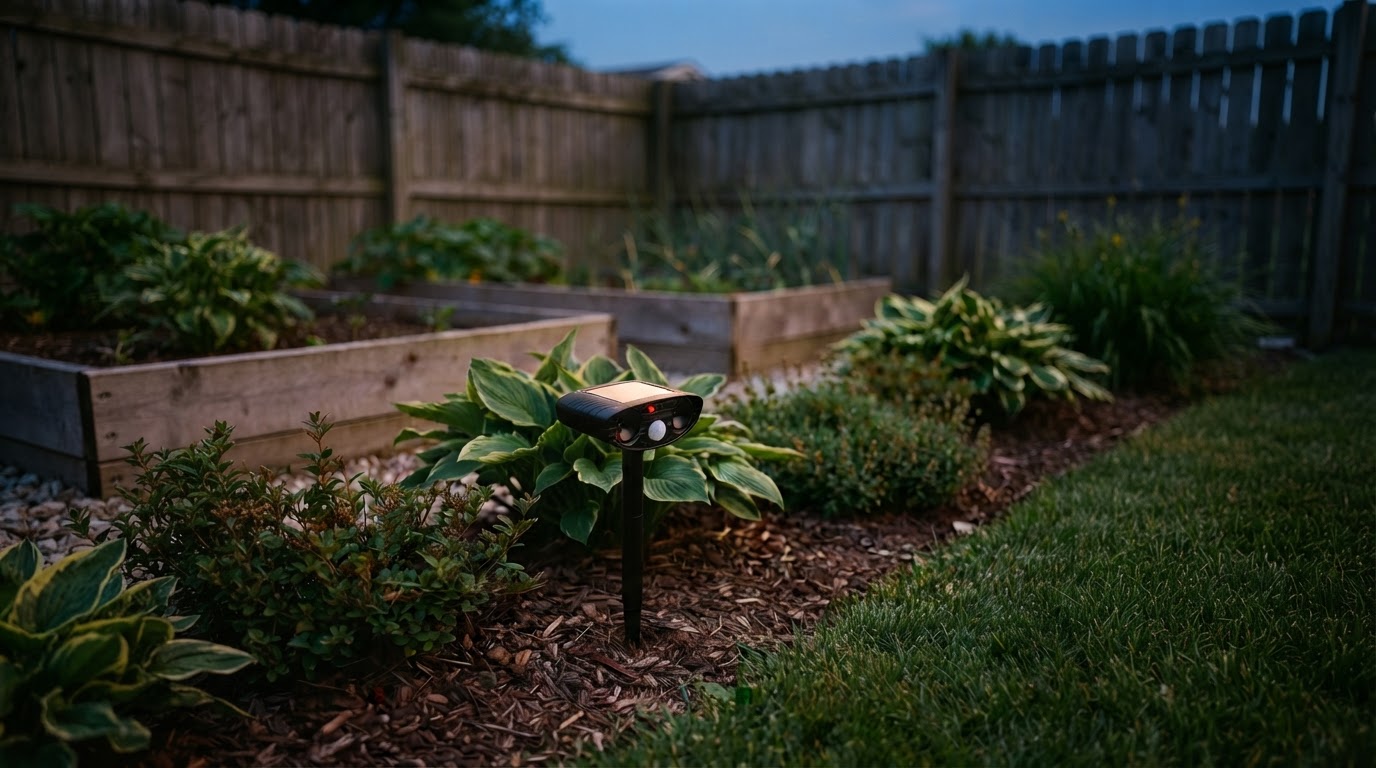
Does the Solar Animal Repellent actually work?
 Maya ChenContributing Editor
October 19, 2026 — Solar Animal Repellent devices effectively deter specific mammalian pests by utilizing high-frequency sound waves and flashing lights, provided the line-of-sight is unobstructed and the battery capacity supports overnight operation.
Homeowners frequently deploy these units to mitigate damage from burrowing rodents and roaming predators without resorting to chemical applications. While consumer sentiment often fluctuates based on unrealistic expectations of "instant" results, the technical efficacy relies on consistent auditory pressure and visual disruption in a targeted zone.
How does the motion sensor distance impact Solar Animal Repellent coverage?
The detection range of a Solar Animal Repellent is the primary bottleneck for effectiveness, as most units only trigger within a 30-foot radius. The conventional wisdom says that a single unit can protect an entire backyard, but the math reveals a different reality: a standard 110-degree sensor angle covers roughly 800 to 900 square feet, meaning a typical suburban lot requires multiple overlapping units to prevent "blind spots" where pests can graze undisturbed. According to Pyle USA, their Serene Life model utilizes a sensor with a 30-foot range, which is standard for the industry but requires precise placement to be effective. Here's the part nobody talks about: if the sensor is blocked by tall grass or decorative shrubs, the infrared trigger fails to activate the ultrasonic burst, rendering the device useless regardless of its solar charge. I’ll change my mind when manufacturers integrate 360-degree radar sensors, but until then, placement is more important than the decibel output itself.
Can a Solar Animal Repellent operate effectively during winter months?
Photo by wr heustis on Pexels
Operational consistency during low-light months is entirely dependent on the milliamp-hour (mAh) rating of the internal battery and the efficiency of the polycrystalline solar panel. Most entry-level devices struggle to maintain a full charge during the shorter days of winter, leading to system failure during the dawn and dusk periods when animal activity peaks. Bird B Gone notes that their Solar Yard Shield features three distinct modes of operation to help manage power consumption, a necessary feature for maintaining function when UV index levels drop. The conventional wisdom says solar devices are "set and forget," but run the math: a unit that triggers 50 times a night requires a significant energy reserve that a small 2-inch panel cannot replenish in four hours of overcast winter sun. Users in northern latitudes often find that performance degrades significantly without supplemental USB charging, a feature found in higher-end Solar Animal Repellent models.
Quick answers
Q: Does the ultrasonic sound affect household pets like dogs or cats? A: While Solar Animal Repellent devices operate at frequencies between 13.5kHz and 45.5kHz, most domestic dogs can hear up to 45kHz, meaning they will likely notice the device if they enter the 30-foot detection zone. Sensitivity varies by breed, but the sound is designed to be annoying rather than harmful.
Q: How long does it take for a Solar Animal Repellent to change pest behavior? A: Data suggests a conditioning period of 2 to 4 weeks is required before animals like squirrels or groundhogs permanently alter their foraging routes. Immediate results are rare because the device relies on creating an "unpleasant environment" that the animal eventually decides to avoid.
Q: Are these devices fully waterproof for heavy rain? A: Most reputable models, such as those sold on eBay or through specialized retailers, carry an IP44 or IP66 waterproof rating. This means they can withstand rain splashes and dust, but they should never be submerged or placed in low-lying areas of the garden where water pools during storms.
Q: What is the most effective frequency for repelling squirrels? A: Squirrels are most responsive to varying frequencies between 25kHz and 30kHz, which is why multi-mode Solar Animal Repellent units often include a sweep function to prevent the rodents from becoming habituated to a single static tone.
For specific applications, see our guide on Solar Animal Repellent for Outdoor Squirrel Control or read our deep dive into Solar Animal Repellent Performance for Squirrel Control. Understanding the limitations of these devices is key to success, as discussed in our overview of outdoor squirrel repellent solar strategies.
Learn more about Solar Animal Repellent at https://solaranimalrepellent.com.
Sources
- Solar Ultrasonic Animal Repellent Review - YouTube
- Solar Yard Shield™ Animal & Pest Repeller - Bird B Gone
- Waterproof Solar Animal Repeller, Ultrasonic Sensor, 30 ... - Pyle USA