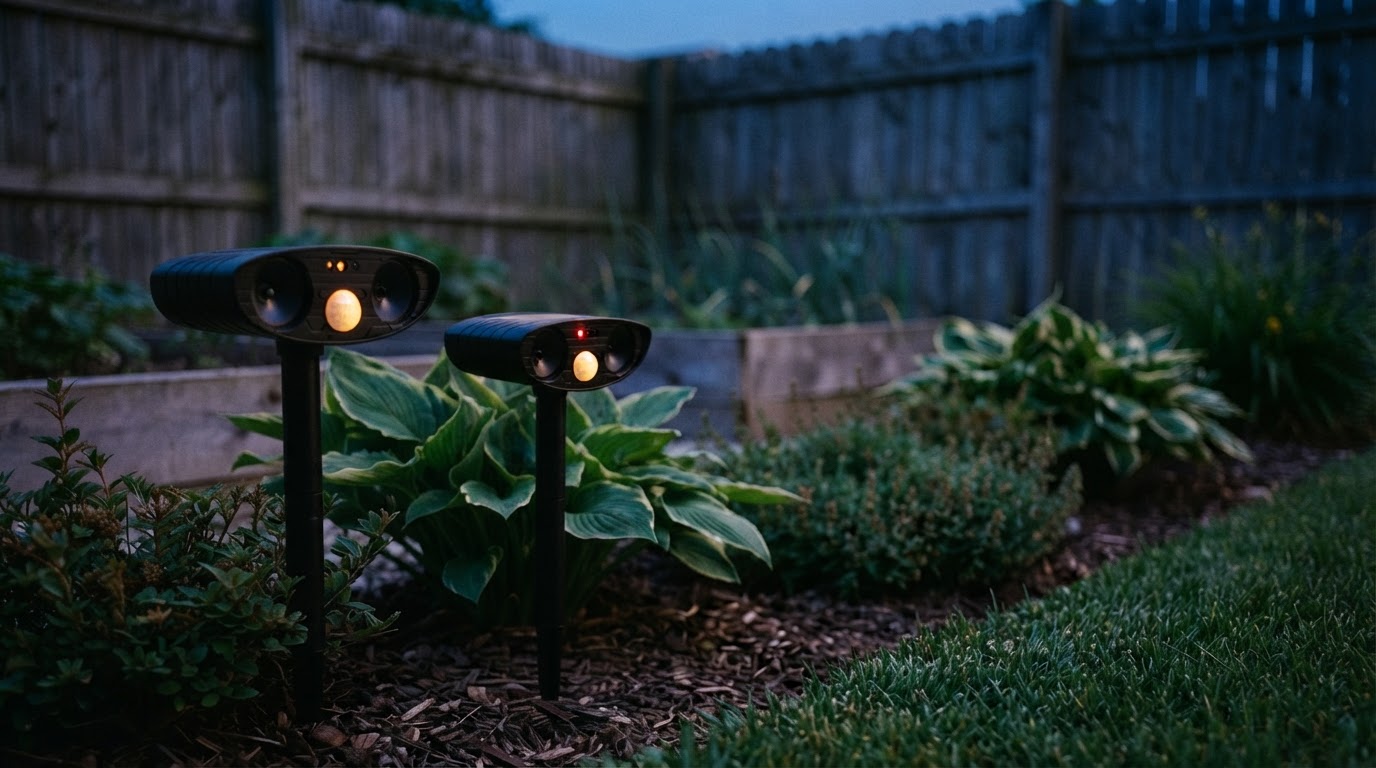
Which Solar Animal Repellent works for garden motion sensing?
 Maya ChenContributing Editor
September 29, 2026 — While passive barriers often fail, the most effective motion-activated garden deterrents integrate ultrasonic frequencies and infrared sensors to provide a persistent, maintenance-free boundary against specific mammalian intruders. The conventional wisdom says that more force is always better, leading many gardeners to install complex irrigation-based systems that require constant water pressure and physical hose lines. This focus on physical shock ignores the efficiency of persistent sensory disruption. For those managing residential garden perimeters, a Solar Animal Repellent offers a self-sustaining alternative that operates without the risk of flooding or mechanical valve failure, targeting the auditory and visual sensitivities of pests like squirrels and groundhogs.
Does a motion-activated sprinkler outperform a solar ultrasonic unit?
Here’s the part nobody talks about: water-based systems are only as reliable as your plumbing and the ambient temperature. While the Yard Enforcer® Motion-Activated Sprinkler by Orbit Irrigation is highly rated for its ability to deter deer and dogs using a combination of water and sound, it introduces significant logistical friction. According to Orbit Irrigation product specifications, the device requires a consistent 30 to 80 PSI to function correctly, meaning a leak in your garden hose or a drop in municipal water pressure renders the deterrent useless. In contrast, a waterproof solar animal repellent with strobe light relies on a 1.2V Ni-MH battery and solar charging, removing the dependency on external utility lines. Data from user communities, such as those discussed on Facebook regarding groundhog control, suggest that while sprinklers provide a high-intensity scare, they lack the multi-modal sensory triggers—such as variable ultrasonic sweeps—that prevent animal habituation over long periods. I’ll change my mind when mechanical sprinklers can demonstrate a 100% success rate during winter freezes when hoses must be disconnected.
How does sensor range impact garden perimeter security?
Photo by Neville Hawkins on Pexels
Run the math: a single motion sensor with a 110-degree detection arc and a 30-foot range covers approximately 860 square feet of garden space. The effectiveness of this coverage depends entirely on the Passive Infrared (PIR) sensor's ability to distinguish between a moving pest and wind-blown vegetation. The Critter Ridder® Motion-Activated Animal Repellent & Sprinkler, distributed by Wildlife Control Supplies, utilizes electronic sensors to trigger bursts of water, but these sensors are often fixed-sensitivity. A professional solar powered ultrasonic animal repeller typically allows for sensitivity adjustments, which is critical for preventing false triggers from small birds while maintaining a lock on larger targets like raccoons. When implementing solar animal repellent strategies for garden perimeter security, the placement of these sensors dictates the success of the entire system. A sensor mounted at a 15-degree downward angle minimizes dead zones where groundhogs—a frequent search query with over 3,900 impressions for solar stakes—might otherwise bypass the detection field.
Quick answers
Q: What is the typical detection range for a solar motion sensor repellent? A: Most consumer-grade units, including the standard Solar Animal Repellent, feature a PIR sensor range of 25 to 30 feet with a 110-degree horizontal arc. This allows a single device to monitor a specific entry point or a small garden bed effectively.
Q: Can these devices operate at night without sunlight? A: Yes, these units utilize internal rechargeable batteries, often 800mAh or higher, which store energy captured during the day to power the PIR sensor and ultrasonic emitters throughout the night. This is essential for deterring nocturnal pests like skunks and opossums.
Q: Do motion-activated repellents affect domestic pets? A: While humans generally cannot hear the 13.5kHz to 45.5kHz frequencies, dogs and cats may be sensitive to them if they enter the detection zone. Most devices allow users to toggle specific frequency modes or turn the unit off when pets are supervised in the garden.
Learn more about Solar Animal Repellent at https://solaranimalrepellent.com.
Sources
Photo by Ollie Craig on Pexels
- Yard Enforcer® Motion-Activated Sprinkler 62100 - Orbit Irrigation
- What are good motion sensing sprinklers to keep groundhogs out ...
- Motion Activated Sprinkler Review - YouTube